This is general information, not tax, legal or financial advice.
For many small shops, makers, and resellers, the end of the year means counting everything on the shelves. It can feel like a chore, but a careful count tells you what you really have, shows where stock goes missing, and gives you a clean starting point for the new year.
This checklist is about doing the count well. It does not cover how inventory is treated for tax or accounting, which depends on your business and where you are. For that, check current rules with a tax professional or your accountant, ideally before you count, so you know what they need from you.
Before the count
Preparation is what makes a count fast and accurate.
Pick a date and time. Choose a quiet time when stock is not moving, such as after closing or on a day you are not selling. If you sell online, consider pausing listings or noting any orders that come in during the count.
Ask what records are needed. Check with your accountant or tax professional what they need from the count and in what format, so you only count once.
Tidy and group stock. Put like items together, move stray items back to their place, and set aside anything damaged, returned, or not for sale so it can be counted separately.
Prepare an item list. List every item with a code or short name, a description, its location, and the unit you count in, such as single items, packs, or meters. If you have a sales system, export what it thinks you have. This is your "expected" number.
Label locations. Give each shelf, bin, or box a simple label. It makes it much easier to split the work and to check later where a difference came from.
Gather supplies. Count sheets or a clipboard, pens, labels or sticky notes to mark counted areas, and a calculator.
During the count
Count one location at a time. Finish a shelf or bin completely before moving on, and mark it as counted.
Count, do not estimate. It is tempting to guess for small items. If you have many of something, count in groups and write the total.
Use two people where you can. One counts and one writes, or one counts and the other checks a sample. Note who counted and who checked on each sheet.
Record counted and expected side by side. For each item, write the expected quantity, what you counted, and the difference. Do not change the counted number to match what you expected.
Write notes as you go. Damaged items, items in the wrong place, and anything you are unsure about should be noted on the sheet, not remembered.
Do not forget hidden stock. Check storage boxes, items at a market stall or with a stockist, items in transit, and stock at home if you work from there.
After the count
Recount big differences. For any item where counted and expected are far apart, recount before you do anything else. Many differences turn out to be miscounts or misplaced stock.
Look for patterns. If the same items are often off, look at why. Are sales not being recorded? Are items being used as samples or given away without being noted?
Update your records. Once you are confident in the count, update your sales system or spreadsheet so the new year starts from accurate numbers.
Make a reorder list. While the numbers are fresh, list items that are low and need ordering, and items that are not selling and might need a plan.
Keep the count sheets. Store the signed count sheets with your year-end records. Ask your accountant how long to keep them.
Make next year's count easier
- Count a few items or one location every month, so year end is a check rather than a surprise
- Record samples, gifts, and damaged stock as they happen
- Keep stock in labeled locations
- Note your count date, who counted, and any problems in one place
We are working on a paperback Inventory Count Log Book with an item index, count sheets with expected, counted, and variance columns, a count summary, and a reorder list. It is coming soon and not available to buy yet. In the meantime, a printed sheet or a spreadsheet with the same columns works well.
Use your count to price better
A count shows you which items move and which sit. If some items take a lot of time to make or source but rarely sell, it may be time to raise their price or drop them. If you sell services as well as products, our free freelance rate calculator can help you check that your hourly pricing covers your costs.
The checklist
- Choose a quiet count date and ask your accountant what they need
- Tidy stock and label locations
- Prepare an item list with expected quantities
- Count one location at a time, with notes
- Record expected, counted, and the difference
- Recount large differences
- Update records and make a reorder list
- Keep the signed count sheets
A calm, organized count gives you numbers you can rely on and a clear picture of your stock going into the new year.
This is general information, not tax, legal or financial advice.
More posts from the blog · All templates and kits · Gifts and apparel · Free tools
Related kits
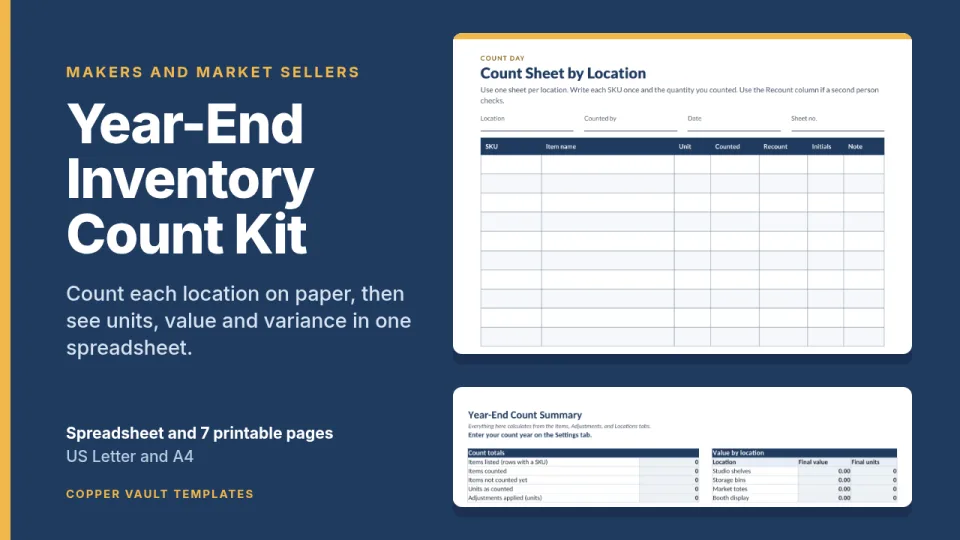
Inventory count kit
Year-End Inventory Count Kit
An inventory count kit for makers and market sellers: list your stock with SKU, location, and unit cost, record your year-end count and adjustments, and see value and variance with reconciliation checks.
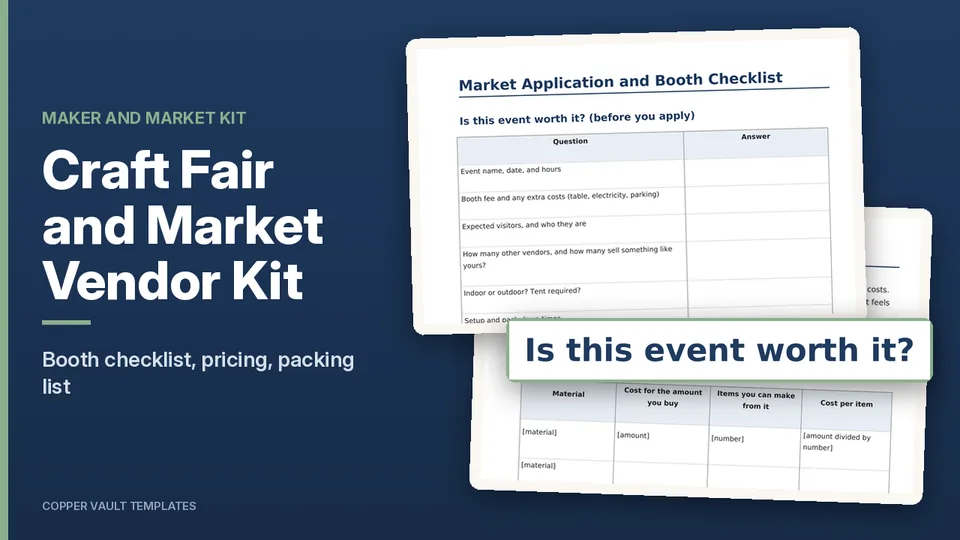
Maker and market kit
Craft Fair and Market Vendor Kit
A craft fair tracker for Microsoft Excel that follows your events, booth fees, stock, and sales, plus a packing list, pricing worksheet, booth sign wording, and payment safety tips.