This is general information, not tax, legal or financial advice.
If you drive to client meetings, job sites, suppliers, or the post office for work, those trips are part of running your business. Many freelancers only think about them once a year, when they try to rebuild months of driving from a calendar and a vague memory. That is slow, stressful, and rarely accurate.
The better approach is boring on purpose: write down each trip when it happens, in the same place, in the same way. This post walks through what to record, a few habits that make it stick, and how to keep the records tidy.
Why a simple log beats memory
Memory is good at the big trips and terrible at the small ones. The two hour drive to a new client sticks. The fifteen minute run to drop off a proof, repeated twenty times over a year, does not. Small trips add up, and they are the ones that fall out of a reconstructed record.
A log also helps you run your business, not just keep records. When you can see how much you drive for each client, you can tell whether a client who needs frequent site visits is really as profitable as they look, and you can price travel into your next quote.
What to write down for each trip
Keep each entry short. The goal is a line you can fill in within a minute of parking. A useful entry usually covers:
- The date of the trip
- Where you went, and where you started if it was not your usual base
- The business purpose, in a few words, such as "kickoff meeting with a new client" or "pick up printing for a market stall"
- The odometer reading at the start and at the end
- The total miles for the trip
- Whether the trip was business, commuting, or personal, if your vehicle is used for more than one
- Any tolls or parking you paid
Write the purpose in plain words that will still make sense to you in a year. "Client" on its own is not enough. "Site photos for the bakery rebrand" is.
What counts as a business trip, and what records are expected, depends on where you live and on your situation. Check the current rules with a tax professional, so you know what to record before the year gets going rather than after.
Pick one place and stick to it
The biggest mistake is spreading trips across a phone note, a calendar, the back of a receipt, and a spreadsheet you meant to update. Choose one home for your mileage and use it every time.
There are three common options:
- A paper log in the car. It is always there, needs no battery or signal, and is quick to fill in at the end of a trip. The trade off is that you have to add it up by hand.
- A spreadsheet. It does the adding for you and makes it easy to sort by client or month. The risk is that you only update it "later", which can turn into never.
- An app. Some apps can record trips automatically. Read how they handle your location data, and check that you can export your records if you stop using the app.
Many people combine two: a paper log for capturing trips on the spot, and a monthly session where they copy totals into a spreadsheet. The important part is that each trip is captured once, the same day.
We are working on a paperback Vehicle Mileage Log Book with trip pages, page totals, and an annual summary. It is not available to buy yet, but the books page will be updated when it is.
Build the habit around moments you already have
Habits stick when they attach to something you already do. A few ideas:
- Before you turn off the engine. Write down the end odometer reading while you are still in the seat. It takes ten seconds and you are less likely to forget it.
- At the start of each work day. If you drive to several places in one day, write the starting reading before you leave and fill in the stops as you go.
- On Friday afternoons. Spend five minutes checking the week's entries against your calendar. Fill any gaps while the week is still fresh.
- At the end of each month. Add up the miles, note the totals per client if that is useful, and file or photograph the pages.
If you miss a trip, add it as soon as you notice, and note that it was added later. A record that is honest about its gaps is better than one that looks perfect but is guessed.
Keep supporting details together
Mileage rarely lives alone. You may also have receipts for parking, tolls, fuel, or repairs. Keep them near your log: an envelope in the glove box, a folder at home, or a photo album on your phone with one folder per month.
It also helps to record your odometer reading on the first day of the year and the last day of the year, along with basic vehicle details. That gives you a clear start and end point, and makes it easier to see business and personal driving side by side.
Use your mileage to price your work
Driving takes time as well as fuel. If a project needs a lot of travel, that time is not available for other paid work. When you can see your real travel for each client, you can decide whether to include travel time in your quote, charge a travel fee, or set a minimum project size for on-site work.
Our free project quote calculator lets you add a line item for travel hours alongside the rest of the work, so it does not quietly disappear from the price. If you are not sure what your hourly rate should be in the first place, start with the freelance rate calculator.
Watch for clients who quietly add trips
Some clients ask for "just one more quick visit" again and again. Each visit costs you time and money, and it can be a sign of a project that is growing beyond what you agreed. Our free 16 Client Red Flags checklist covers scope creep and other early warning signs, with a calm next step for each one. When an extra visit is real extra work, the scope change cost estimator helps you put a fair number on it before you say yes.
A quick start checklist
- Choose one place for your mileage records
- Write today's odometer reading on the first page
- Decide on the details you will record for each trip
- Pick the moment you will fill it in, such as before you turn off the engine
- Set a monthly reminder to add up totals and file receipts
- Ask a tax professional what records apply to you
Start small and keep going. A plain, consistent record kept all year is far more useful than a perfect system you abandon in March.
Prefer paper? The Vehicle Mileage Log Book is a printed 6 x 9 inch paperback for logging trips by hand, $9.99 on Amazon.
This is general information, not tax, legal or financial advice.
More posts from the blog · All templates and kits · Gifts and apparel · Free tools
Related kits
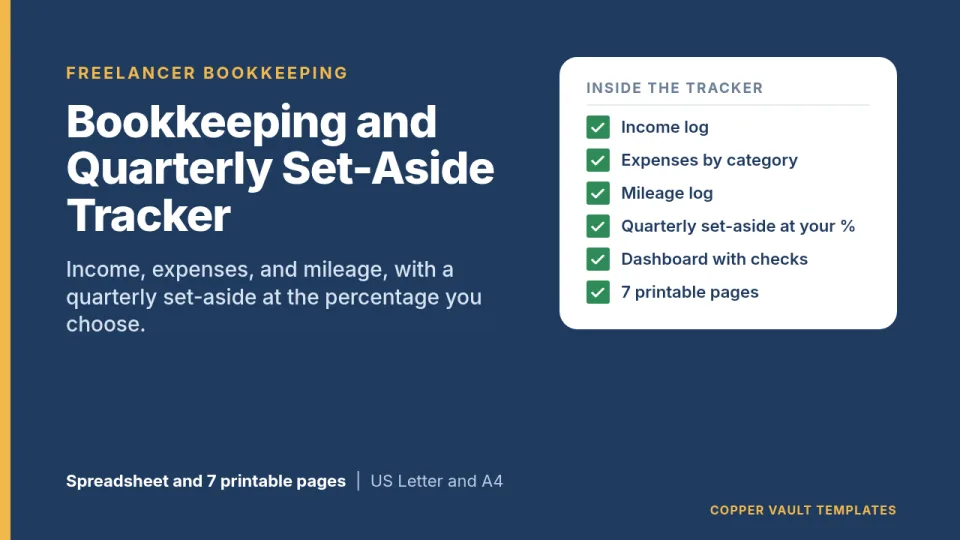
Bookkeeping spreadsheet
Freelancer Bookkeeping and Quarterly Set-Aside Tracker
A bookkeeping spreadsheet for freelancers that tracks income, expenses by category, and mileage, plans a quarterly set-aside based on the percentage you choose, and checks that your totals add up.