This is general information, not tax, legal or financial advice.
Most project problems start with a question nobody asked. Who signs off on the work? Is there a launch date the client forgot to mention? Did they have a bad experience with the last freelancer? A client intake questionnaire gathers these answers in writing before you start, so your first conversation can focus on decisions instead of basic facts.
This post is about the questions themselves: what to ask, how to word it, and what to leave out. If you want the wider set of steps around starting a project, such as scope, kickoff, and the first week, see our client onboarding checklist for freelancers.
What a client intake questionnaire is for
An intake questionnaire is a short set of written questions you send to a new client, usually right after they agree to work with you. It does three jobs:
- It collects facts you need once, in one place, instead of scattered across emails
- It shows you where the client is unsure, which tells you what to discuss on your first call
- It gives you a written record to look back on when a detail is disputed later
Keep it short enough to finish in about 15 minutes. A long form tends to come back half done.
Questions to ask a new client, in eight sections
Group your questions so the client can move through them easily. Here are eight sections that suit most service work. Pick the questions that fit your field and drop the rest.
1. About the business
- What does your business do, in one or two sentences?
- Who are your main customers?
- What makes you different from similar businesses?
- Is there anything about your business I should know before we start, such as a busy season?
2. The goal of this project
- What do you want this project to achieve?
- Why now? What prompted this project?
- How will you know it worked?
- What would make this project a disappointment?
The last question is one of the most useful you can ask. People often find it easier to describe what they want to avoid than what they want.
3. The audience
- Who is this work for?
- What do they need to know, feel, or do after seeing it?
- What questions or doubts do they usually have?
4. Examples and preferences
- Share two or three examples you like, and say what you like about each
- Share one or two examples you do not like, and why
- Are there words, colors, or styles to avoid?
- Do you have brand guidelines, a logo, or existing materials I should use?
Examples save hours. "Make it modern" means different things to different people, but a link with a note means something specific.
5. Timing
- Is there a fixed date this needs to be ready for, such as a launch or an event?
- Are there dates when you or your team are unavailable?
- How quickly can you usually give feedback?
Feedback speed matters as much as your own speed. A project with a two day turnaround on your side and a two week turnaround on theirs will run late.
6. People and decisions
- Who is my main contact day to day?
- Who gives final approval on the work?
- Is anyone else involved who has not been in our conversations yet?
A surprise decision maker who appears at the final stage is a common cause of rework. Asking early lets you include them from the start.
7. Communication
- How do you prefer to communicate: email, calls, or a messaging tool?
- What time zone are you in?
- How often would you like updates?
8. Practical details
- Who should invoices go to, and is there a purchase order or reference number to include?
- Which tools, files, or accounts will I need access to? (You will set up access separately; this question is only about the list.)
- Have you worked with a freelancer on something like this before? What went well, and what would you change?
That final question tells you a lot about expectations, and it often surfaces worries the client would not raise on their own.
How to word intake questions
Good intake questions are easy to answer and hard to misread.
- Ask one thing per question. "What is your goal and budget and deadline?" gets a partial answer.
- Prefer open questions for goals. "What do you want this to achieve?" gets more than "Do you want more sales?"
- Prefer short choices for facts. Time zone, preferred channel, and update frequency can be simple options.
- Use plain words. Skip industry terms the client might not know.
- Mark the questions you cannot start without. Clients skim. A small note such as "needed to start" shows them where to focus.
What to leave out of your intake form
Some things do not belong in a questionnaire.
- Passwords and login codes. Ask for access through each tool's own sharing or team settings instead.
- Sensitive personal data you do not need, such as ID numbers or full bank details. Collect only what the work requires.
- Questions you already know the answer to. Fill in what you learned on the sales call and ask the client to confirm it.
- Anything that reads like a test. The questionnaire should feel like help, not homework.
If you work in a field with its own rules about client information, such as health or finance, check what applies to you before you design your form, or ask a qualified professional.
When and how to send it
Send the questionnaire as soon as the client has agreed to go ahead, with a clear date for returning it. A shared document, a simple form tool, or an editable file all work. Choose whatever your client will find easiest, not whatever looks most impressive.
When the answers come back, read them before your first call and note three things:
- Answers that are clear and need no discussion
- Answers that are vague or missing
- Answers that change your plan, such as a new deadline or a new decision maker
Bring the second and third lists to the call. That keeps the conversation short and focused.
Reuse it for every client
Once your questionnaire works, save it as a template. Each new client then takes minutes to set up, and you build a consistent record of how every project started. Review it every few months and remove any question that rarely gets a useful answer.
A ready made questionnaire
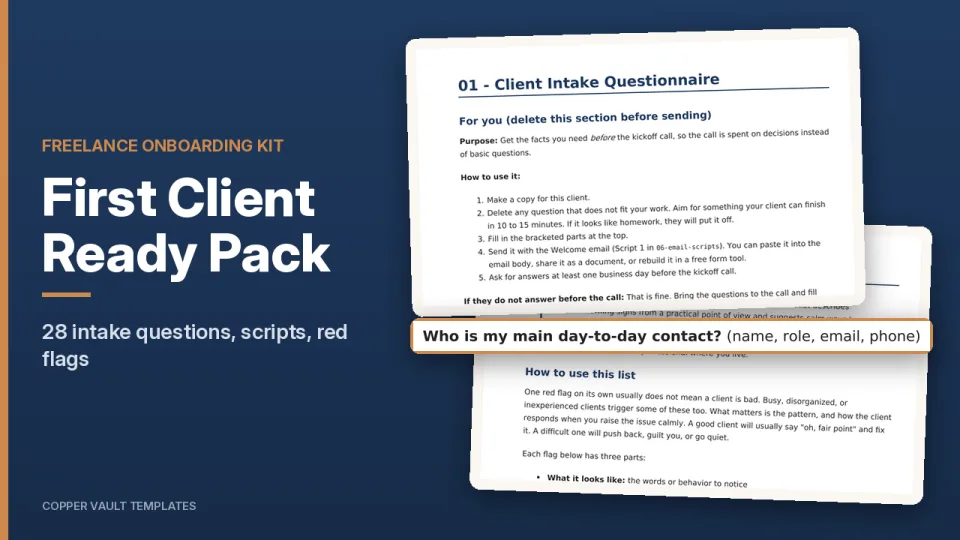
If you would rather start from an existing set of questions, the First Client Ready Pack includes a client intake questionnaire with 28 questions across 8 sections, with the must ask ones marked. The pack also has an access and owners checklist, a definition of done worksheet, kickoff call agendas, and five email scripts, in PDF, Word, and Markdown.
Quick recap
- Send a short questionnaire right after the client says yes
- Cover the business, goal, audience, examples, timing, people, communication, and practical details
- Ask what would make the project a disappointment
- Word each question simply, one idea at a time
- Leave out passwords and sensitive data you do not need
- Read the answers before your first call and bring the gaps to it
This is general information, not tax, legal or financial advice.
More posts from the blog · All templates and kits · Gifts and apparel · Free tools
Related kits
Freelance onboarding kit
First Client Ready Pack
8 editable templates in PDF, Word, and Markdown to take your first freelance client from yes to a smooth first week.