This is general information, not tax, legal or financial advice.
The Holiday Budget and Gift Tracker Kit is a practical planning tool, not financial, tax, or legal advice. Decide for yourself what you can afford to spend.
The holidays rarely fail because of one big purchase. They get expensive in small steps: a host gift you forgot to list, a second grocery run, postage for a longer card list, and a few "while we are here" extras. If the only number you have is a vague sense of what you wanted to spend, it is easy to find out after the fact that you went past it.
A holiday budget does not have to be a full year-round money system. It only has to answer three questions, in one place: what is the total, how is it split, and what have you already spent.
Start with a total you can live with
Pick a total for the whole holiday season before you start buying gifts or booking travel. Use a number that fits the rest of your household plans, not a number that looks festive on paper. This is not a judgment about what anyone should spend. It is a ceiling you chose on purpose.
Write the total down. A number that lives only in your head tends to drift up each time a new cost appears.
Split the total into a few categories
Once you have a total, split it into the groups that actually show up in your season. A useful starting set is:
- Gifts
- Food and hosting
- Decor
- Travel
- Cards and postage
Rename those groups or add your own if your year looks different. A household that is not traveling can give that slice back to gifts or food. A household that hosts a large meal may need more in food and hosting than in decor.
The point of categories is not perfect accounting. It is to see, early, that one group is crowding out the others, while you can still change course.
Track gifts by person, not as one lump
A single "gifts" total hides the usual surprises: two people with the same first name, a gift marked as bought with no price written down, or a long list that is still waiting to be wrapped. A gift list works better when each row is one person (or one household) and holds the facts you need later:
- A budget for that person
- A gift idea
- Whether it has been bought
- The price you actually paid
- The store
- Whether it is wrapped
- Whether it has been delivered or given
If two people share a name, add a short label, such as a last name or "coworker," so you can tell them apart. If a gift is marked bought and the price is still blank, go back and fill it in, or you will undercount what is already spent.
Keep a short spending log
Categories only stay honest if you record spending as it happens. A simple expenses log, with the date, the category, and the amount, is enough. You do not need a new app. You need one list you trust.
When the log and the gift list are in the same place, you can see both what is left in the total and what is left to buy, wrap, or send. That is more useful, mid-season, than a bank balance alone.
A weekly habit beats a December scramble
A holiday budget works when you look at it on a regular cadence, not only when something feels expensive. A week-by-week checklist, starting several weeks out and running through the days after, is a practical way to do that: review the total, update prices, and move anything that is still open (a gift not yet bought, a card not yet mailed) onto this week's list.
The aim is a short review, not a new project each Sunday.
Paper, a spreadsheet, or both
Some people think more clearly on paper. A printable gift list and a paper budget by category can be enough for a small season. If your list is longer, or you want spent and remaining calculated for you, a spreadsheet is easier to keep current.
The Holiday Budget and Gift Tracker Kit is made for this job. It costs $9 and includes a Holiday Budget and Gift Tracker spreadsheet, a printable gift list, a holiday budget worksheet, a food and hosting planner, checklists for cards, decor, and travel, a week-by-week planning checklist, and a start here guide. The tracker is made for Microsoft Excel, and it has been tested in Google Sheets and LibreOffice Calc. It uses simple formulas with no macros. The printables come as PDF, Word, and Markdown. It is an instant digital download, sold on Etsy and on Gumroad, and nothing is shipped.
For printable tags and a short gift list, see the Holiday Gift Tags and Planner. For a name draw and questionnaires, see the Secret Santa and Gift Exchange Kit. Apparel and illustrated gifts are in our Gifts and apparel shops.
The kit is for the family organizer who handles the gifts, the meals, and the cards. It is not a full year-round budgeting or bookkeeping system, and it does not help with debt.
Keep the system small on purpose
If you only do four things, do these:
- Write down a total you can afford
- Split it into a few categories you can rename
- Give each gift its own row, with a price once it is bought
- Log other spending in the same place, in short weekly reviews
That is enough to see what you have spent and what is left, before the season is over and the number is only a surprise.
This is general information, not tax, legal or financial advice.
More posts from the blog · All templates and kits · Gifts and apparel · Free tools
Related kits
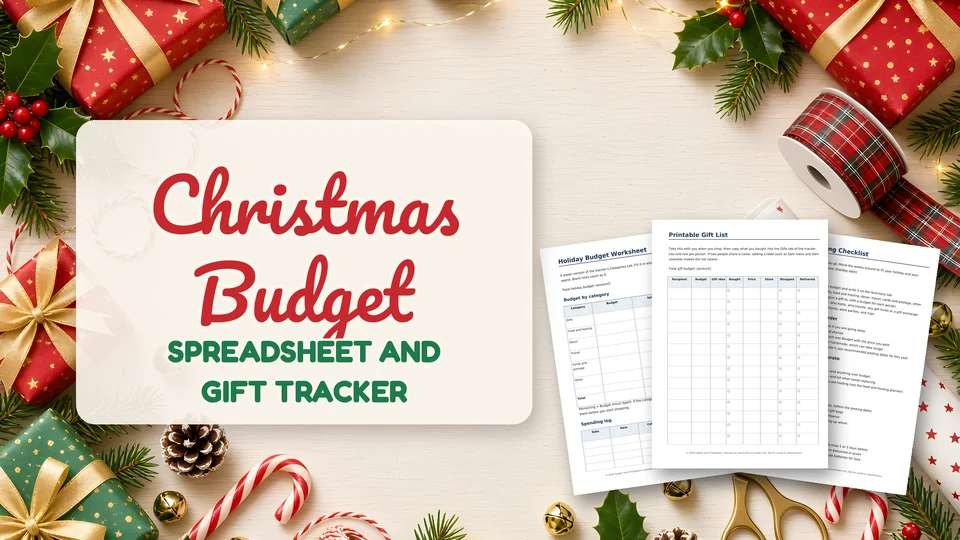
Holiday planning kit
Holiday Budget and Gift Tracker Kit
A holiday budget and gift tracker for Microsoft Excel, Google Sheets, and LibreOffice Calc that shows what you have spent and what is left, plus a printable gift list and checklists for hosting, decor, travel, and cards.
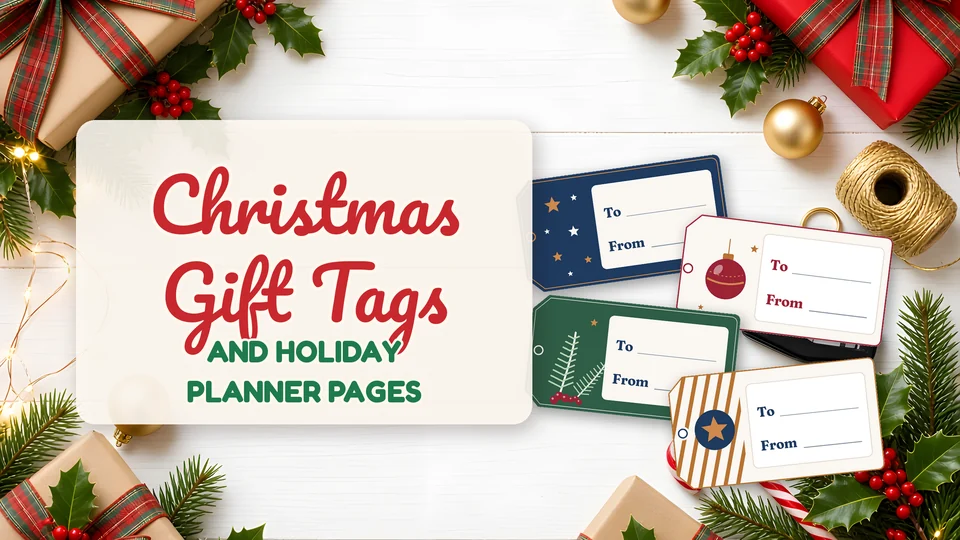
Holiday printables
Holiday Gift Tags and Planner
50 printable holiday gift tags in four designs, plus a gift list, holiday card list, week by week December countdown and one-page holiday budget summary. US Letter PDFs.
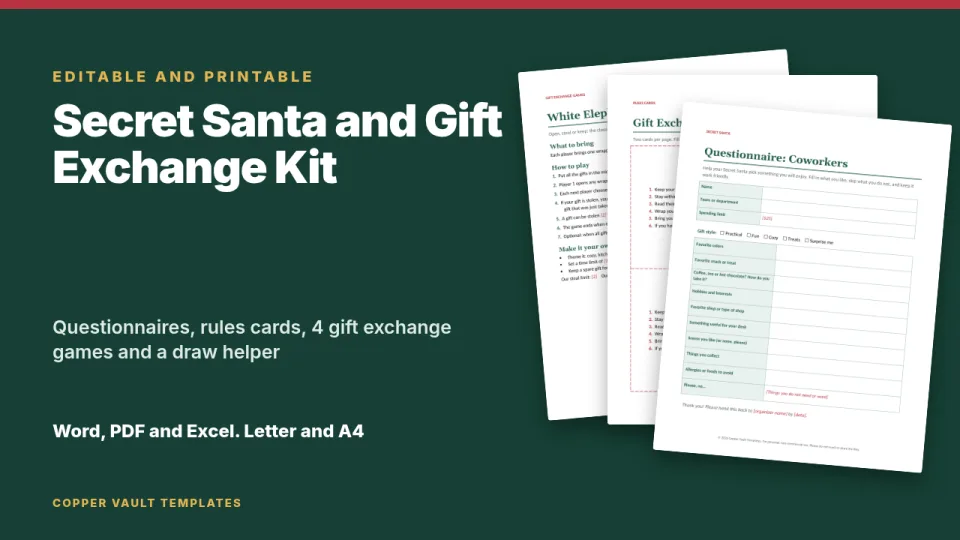
Gift exchange kit
Secret Santa and Gift Exchange Kit
Run Secret Santa at work, with family or with friends: editable Word questionnaires, a sign up sheet, rules cards, 4 gift exchange games and a name draw spreadsheet, in US Letter and A4.